
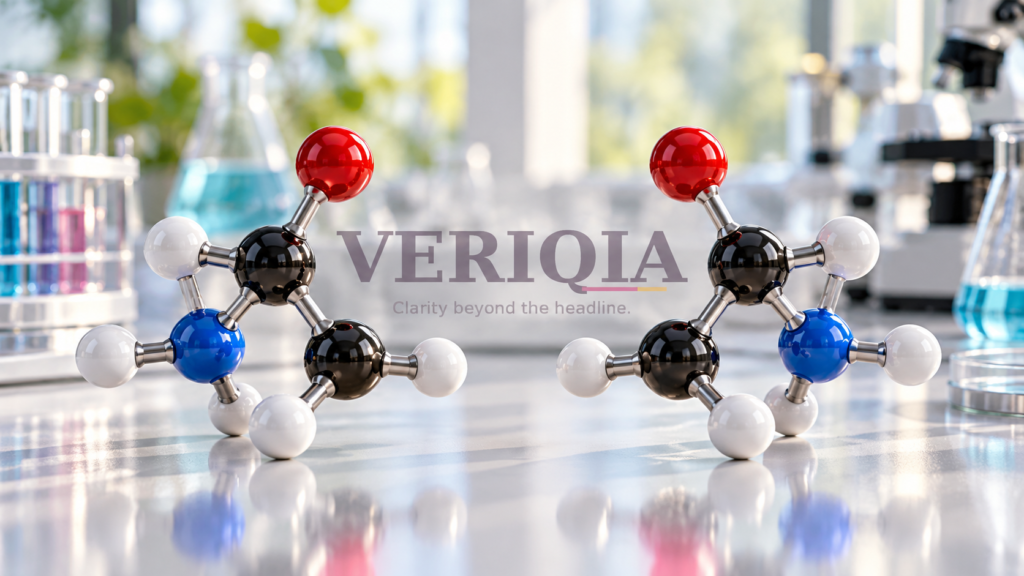
Nobel Chemistry Prize 2026 Explained: Why Mirror-Image Molecules Matter
Henri B. Kagan and Kenso Soai won the 2026 Nobel Prize in Chemistry for discoveries about how chemical reactions can favor one mirror-image form of a molecule. Their work helps explain how a small imbalance can grow into a much larger one.
The announcement on October 7 puts a difficult-sounding idea into the headlines: molecular handedness. The easiest place to start is with your own hands.
What are mirror-image molecules?
Your left and right hands look alike in a mirror, but you cannot place one exactly over the other in the same orientation. Some molecules have a similar property. They contain the same kinds of atoms connected in the same way, yet their three-dimensional arrangements are mirror images that cannot be superimposed.
Chemists call this property chirality. The two mirror-image forms are called enantiomers. These words describe structure; they do not mean that one form is always good and the other always bad.
What did Kagan and Soai discover?
Kagan’s work showed that the balance between two mirror-image forms in a catalyst can produce a surprisingly large imbalance in the reaction’s products. The result does not always follow a simple proportional relationship. This is the idea behind a nonlinear effect in asymmetric synthesis.
Soai studied asymmetric autocatalysis. In autocatalysis, a reaction product helps the reaction make more product. In the chemistry recognized by the prize, this can amplify molecular handedness: a small initial preference can become much more pronounced as the reaction continues.
Why does the shape of a molecule matter?
Biological systems are three-dimensional. A molecule’s arrangement can affect how it interacts with another structure. That is one reason controlling molecular handedness is important in pharmaceutical chemistry.
A hand-and-glove comparison is useful: the same glove shape does not fit both hands in the same way. The comparison is only a starting point, because real molecules can move and interact through complicated chemistry. Still, it explains why a list of atoms alone does not tell the whole story.
What does homochirality mean?
Homochirality describes the strong preference for one handed form seen in important biological building blocks. How such preferences could arise is a major scientific question. The prize-winning reactions provide ways to investigate how chemical processes amplify asymmetry.
They should not be read as a complete account of every step in the origin of life. Their value is that they reveal mechanisms scientists can test, rather than simply assume.
Three terms to remember
- Chirality: a structure has a distinct mirror-image partner.
- Asymmetric synthesis: a reaction favors one handed form.
- Autocatalysis: a product helps the reaction produce more of itself.
The practical connection is control. Chemists want to understand which form a reaction produces, why it becomes dominant and how to reproduce that result. The 2026 prize recognizes discoveries that made those questions easier to investigate.