India Business Growth Reaches Four-Month High While Hiring Stalls
Business activity strengthens while recruitment barely moves
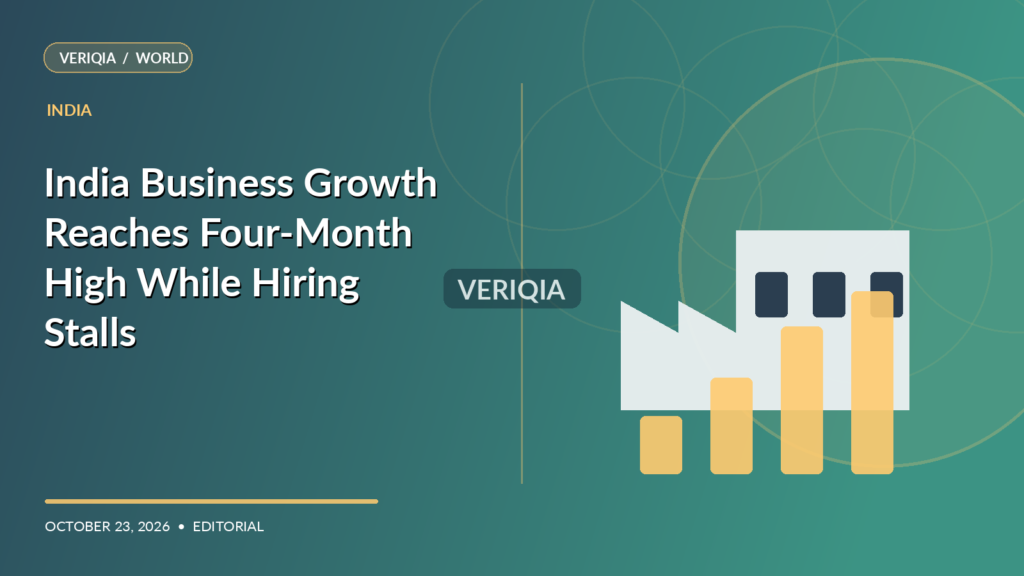
India's private-sector business activity expanded at its fastest pace in four months in October, according to a preliminary purchasing managers' survey reported by Reuters on October 23. Stronger orders and a pickup in services supported the improvement, but employment growth nearly stalled. The contrast is important: companies can report more work without immediately hiring more people. Managers may increase hours, use existing capacity or wait to see whether demand persists. The preliminary survey provides an early view of economic conditions rather than a final measure of output or employment. It suggests improving momentum in parts of the private economy while leaving questions about the breadth and durability of job creation.
What a purchasing managers' index measures
A purchasing managers' index, or PMI, is based on surveys of businesses about changes in activity, new orders, employment, prices and related conditions. It is designed to capture the direction and pace of change rather than the total value of production. A reading above 50 generally indicates expansion compared with the previous month, while a reading below 50 indicates contraction. The flash version uses responses available before the final survey is complete. It can be revised as more data arrive. PMI is useful because it is timely, but it should be read alongside official industrial production, national accounts, inflation and labour-market statistics. One survey cannot describe the entire economy, including informal work and public-sector activity.
Why services can lead an expansion
Services cover a wide range of activities, from technology and finance to transport, hospitality and business support. Growth in new orders can increase workloads quickly, particularly when companies already have trained staff and systems in place. The October survey indicated that services were a major contributor to stronger overall activity. That does not mean every service business is growing or that manufacturing has become unimportant. Different industries respond to domestic spending, exports and investment at different speeds. Analysts should look for whether the expansion is concentrated in a few sectors or supported by broad demand. The composition of growth matters because it influences the types of jobs and investment that may follow.
Why hiring may lag behind orders
Recruitment decisions often follow demand with a delay. Businesses may first use overtime, temporary arrangements or productivity improvements before committing to permanent employees. Higher wages, financing costs and uncertainty about future orders can also make managers cautious. Reuters reported that employment growth nearly stalled despite stronger workloads. That is a signal worth monitoring, not proof that jobs are being eliminated across the economy. Survey employment measures reflect participating companies and can differ from household employment data. If demand remains strong for several months, firms may eventually need additional staff. Alternatively, companies may find ways to produce more with the same workforce. The next surveys will help clarify which pattern is emerging.
What the report means for workers
A strong business-activity reading can be encouraging, but job seekers need evidence that hiring is actually increasing in their sectors and regions. Employers may prefer experienced candidates when demand is uncertain, leaving new graduates with fewer opportunities even during an expansion. Workers should not assume that an upbeat headline guarantees rapid wage growth. Pay depends on labour supply, skills, productivity and the financial position of employers. The near-stall in hiring is therefore an important part of the story. Policymakers interested in inclusive growth will watch whether rising output creates accessible jobs rather than concentrating gains among existing firms and employees. Training and labour mobility can help, but they do not replace the need for real vacancies.
Inflation and interest-rate implications
Stronger demand can support investment and tax revenue, but it can also create price pressure if capacity is constrained. Purchasing managers' surveys often include questions about input costs and selling prices, which can provide early inflation signals. India also faces exposure to global oil prices and currency movements. Policymakers must weigh growth against inflation rather than treating every acceleration as unambiguously positive. A central bank generally looks at a wider set of indicators before changing rates. The flash PMI alone should not be presented as a prediction of the next monetary-policy decision. Its value lies in showing whether business conditions are improving and whether that improvement is accompanied by changes in costs and staffing.
How businesses can use the signal
Companies may use the survey as one input when planning inventories, staffing and capital spending. A sustained rise in orders can justify investment in equipment or hiring, but an isolated monthly improvement may not. Suppliers should also consider whether customers are ordering for immediate use or rebuilding inventories after earlier shortages. Service businesses need to assess whether they can maintain quality as workloads rise. If staff numbers remain flat while demand grows, pressure on employees can increase. Managers should monitor delivery times, customer complaints and overtime costs rather than relying only on sales. The report's combination of faster activity and subdued hiring makes operational capacity an important question for the coming months.
What to watch next
The final October PMI readings will provide a fuller picture, followed by official data on production, consumption and employment. Analysts will look for whether new orders remain strong, whether manufacturers share in the acceleration and whether hiring begins to respond. Differences between survey results and official statistics should be examined rather than ignored, since they measure different things. Reuters' October 23 account describes a four-month high in business momentum alongside nearly stagnant recruitment. That is a nuanced signal: the private economy appears to be expanding more quickly, but the benefits have not yet translated into broad new hiring. The durability of demand and the response of employers will determine whether that gap narrows.