
Rahul Gandhi’s Surname Opened Doors. Should India Keep Rewarding Political Dynasties?
VERIQIA In Depth
What does it take to become a national political leader in India? Years of local organising, a record in public office, and the support of voters should matter. Yet a famous surname can put someone at the centre of the conversation before those tests begin. Rahul Gandhi’s career makes that imbalance impossible to ignore.
His supporters see a politician who has challenged the government and argued for greater social representation. His critics see a Congress leadership that keeps returning to the same family. Both sides should face the harder question: Would an equally capable outsider have been given the same platform?
Is Rahul Gandhi’s name really Rahul Gandhi?
Yes. His official parliamentary profile identifies him as Rahul Gandhi, the Congress member for Rae Bareli. He has served as Leader of the Opposition in the Lok Sabha since 2024. Online claims that a different name is his hidden official identity need evidence; a viral post is not proof.
The family’s Gandhi surname comes through his grandfather Feroze Gandhi, who married Indira Nehru. The Nehru-Gandhi political family is not descended from Mahatma Gandhi. The shared surname has generated confusion, but the distinction is straightforward.
How much political power did he inherit?
Rahul Gandhi’s great-grandfather Jawaharlal Nehru, grandmother Indira Gandhi and father Rajiv Gandhi all served as prime minister. His mother Sonia Gandhi led the Congress for years, and his sister Priyanka Gandhi Vadra is a Congress politician. No family can hand someone a parliamentary seat without an election. It can, however, hand them recognition, networks, access to party decision-makers and a national audience.
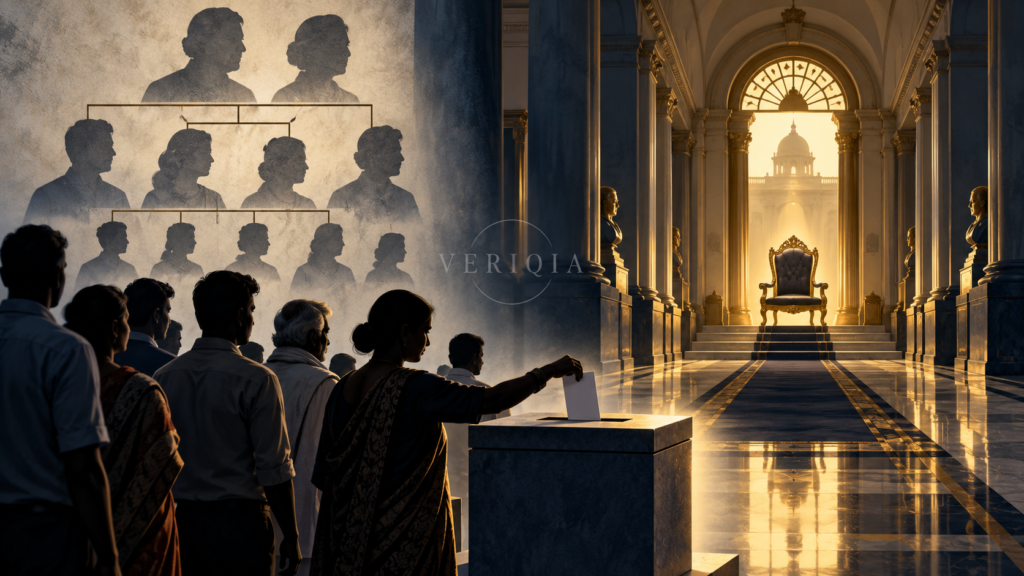
That is the source of the anger over dynastic politics. Millions of party workers can spend decades trying to be heard. A political heir begins with a microphone. Whether he uses it well is a separate test, but pretending that everyone reached the starting line in the same way insults the work of people outside the family circle.
Is Congress the only party with dynasties?
No. Political families operate across Indian parties and regions. Research on earlier Lok Sabhas found a substantial share of MPs had dynastic backgrounds. The problem is broader than a single surname: parties can become closed ladders when nominations and leadership positions circulate through relatives and established networks.
Calling out one dynasty while excusing another turns a democratic principle into a party slogan. A consistent standard asks every party how a capable first-generation politician can rise without family connections.
Should Rahul Gandhi answer for Indira Gandhi’s Emergency?
He should answer questions about the political legacy he invokes, but he did not impose the Emergency. From 1975 to 1977, civil liberties and press freedom were curtailed and political opponents were jailed under his grandmother’s government. It is fair to ask what Congress learned from that period. It is inaccurate to assign Rahul Gandhi personal responsibility for decisions made before his adult political career.
The same distinction applies to the 1984 anti-Sikh violence and the long-running arguments about the role of Congress figures. Rahul Gandhi was a teenager. Historical accountability for a party must not be rewritten as a personal allegation against a child at the time.
What controversies involve Rahul Gandhi himself?
In a criminal defamation case over remarks about the Modi surname, a Gujarat court convicted him in 2023 and imposed a two-year sentence. He was disqualified from Parliament. The Supreme Court later stayed the conviction, noting that the trial court had not adequately explained the maximum sentence and that disqualification affected voters’ representation. The stay did not decide the underlying appeal on its merits.
The National Herald matter is another serious and contested dispute. The Enforcement Directorate has alleged wrongdoing involving Sonia Gandhi, Rahul Gandhi and others; they deny the allegations. A Delhi trial court declined in December 2025 to take cognisance of the agency’s prosecution complaint on legal grounds, and the agency challenged that decision. As of September 2026, the fight was continuing in the Delhi High Court. An allegation is not a conviction. Readers can demand answers without turning an unresolved case into a verdict.
What policies should voters actually examine?
Congress’s 2024 manifesto proposed a nationwide socio-economic and caste census and a constitutional amendment to raise the 50% cap on reservations for Scheduled Castes, Scheduled Tribes and Other Backward Classes. Rahul Gandhi has championed these ideas. Supporters argue better data can expose exclusion; critics question how the proposals would affect opportunity, social cohesion and the design of benefits.
The manifesto also proposed ₹1 lakh a year for eligible poor families under Mahalakshmi, generally paid to the oldest woman in the household. That promise invites specific questions: who would qualify, how would eligibility be checked, and how would it be funded? Those questions are more useful than claims about a secret plan to ruin the country.
Has he earned his position independently of his surname?
There is no single measurement. He has contested and won elections, lost elections, campaigned across the country and become the formal leader of the opposition in the Lok Sabha. Those are political facts. So is the extraordinary advantage with which he entered public life.
Voters can judge his arguments and performance without treating inherited access as either a crime or an achievement. The sharper demand belongs to his party: show how leadership is earned, how candidates are selected and whether a non-dynastic worker could realistically reach the same level.
What should a voter ask of every political heir?
- What has this candidate personally accomplished?
- Would the party have promoted them without the family name?
- How are ordinary members selected and advanced?
- What evidence supports the candidate’s policy claims?
- Will the party hold relatives to the same standards as everyone else?
The uncomfortable truth is that voters may accept a dynasty while still wanting open competition. Elections give citizens the power to reject a candidate; they do not guarantee that parties gave citizens a broad choice in the first place. Rahul Gandhi is the most recognisable test of that problem, but the standard should apply to every political family in India.