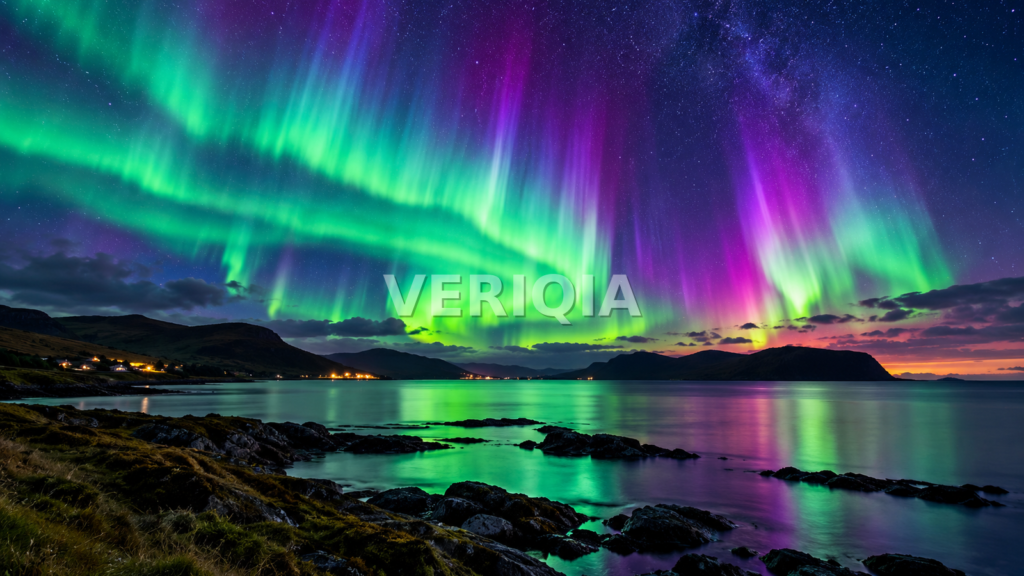
Northern Lights Tonight: Why the Aurora Can Reach the UK and How to Check Your Chances
Yes, the northern lights can sometimes be visible from the UK when solar activity disturbs Earth’s magnetic field enough to expand the auroral oval southward. On 12 October 2026, official UK space-weather guidance said glancing coronal mass ejections followed by a fast solar-wind stream could enhance the auroral oval through 14 October, with sightings possible across Scotland and places at similar geomagnetic latitudes where skies are clear.
The most important point is that an aurora forecast is a chance, not a guarantee. Space weather has to cooperate, the sky has to be dark enough, clouds must stay away, and your local horizon needs to be reasonably free of bright city light.
Why are the northern lights sometimes visible farther south?
The aurora starts with energy from the Sun. Charged particles and magnetic fields travel through space in the solar wind. When conditions are favorable, that energy interacts with Earth’s magnetosphere and sends particles toward the upper atmosphere near the poles.
Those particles collide with gases high above Earth. Oxygen and nitrogen release light in different colors, which is why an aurora can appear green, red, purple or pink. During stronger geomagnetic activity, the auroral oval can widen. That is when places farther from the Arctic, including parts of the UK, can get a chance to see it.
What does “aurora possible” actually mean?
A useful aurora forecast combines two very different things:
- Space weather: how disturbed Earth’s magnetic environment may become.
- Local weather: whether you will actually have clear, dark skies at your location.
You can have strong geomagnetic activity and still see nothing under thick cloud. You can also have beautifully clear skies but weak auroral activity that stays too far north.
Do not rely on one number alone
People often focus on the Kp index, a global measure of geomagnetic activity. It is useful, but it is not a precise street-level visibility forecast. Aurora can brighten suddenly, change shape quickly and become visible from places where a simple Kp rule would suggest only a marginal chance.
A better approach is to check an official space-weather forecast, then compare it with your local cloud cover, darkness and northern horizon.
Where in the UK is the best chance?
Scotland usually has the strongest chance because it is farther north and closer to the typical auroral oval. Northern England and Northern Ireland can also see displays during stronger events. Under unusually favorable conditions, the lights can become visible much farther south.
For any location, try to find:
- a dark place away from street lights;
- a clear view toward the north;
- low cloud cover;
- little or no moon glare if the aurora is faint; and
- enough time to wait, because activity often comes in bursts.
What time should you look?
There is no single perfect clock time. The sky must first be dark. After that, the best window depends on the arrival of solar-wind structures and how Earth’s magnetic field responds.
If an official forecast covers the whole night, do not assume the aurora will be continuously visible. Check updates during the evening and be ready for short periods of stronger activity.
Can a phone camera see more than your eyes?
Often, yes. Modern phones can use longer exposures and computational photography to collect more light than your eyes perceive instantly. A faint greyish glow to the naked eye can show stronger green or purple in a photo.
For a cleaner result:
- steady the phone against a wall, tripod or solid surface;
- use night mode if available;
- avoid digital zoom;
- tap the sky to set focus and exposure; and
- review the image before assuming the display is too faint.
How to plan an aurora trip without overpacking
If you are travelling specifically to chase the lights, remember that the best viewing areas can be remote, cold and dark. Keep your phone charged and know the rules for carrying batteries before flying. VERIQIA’s guide on taking a power bank on a plane is useful if you are packing camera or phone backup power.
For an overseas trip, also think about connectivity because aurora forecasts can change while you are out. Our guide to how much travel eSIM data you need for a one-week trip can help if you plan to use weather maps, navigation and live forecast apps.
Quick aurora checklist
| Check | Why it matters |
|---|---|
| Official space-weather forecast | Shows whether geomagnetic conditions may support an expanded auroral oval. |
| Cloud cover | Cloud can completely block an otherwise strong display. |
| Darkness | Faint aurora is much easier to see away from twilight and artificial light. |
| Northern horizon | At lower latitudes, the aurora may sit low in the north rather than overhead. |
| Phone night mode | Can reveal colors and structure that are hard to see with the naked eye. |
The bottom line
The current surge in northern-lights interest is understandable: the UK has a real viewing opportunity when space weather pushes the auroral oval south. But success still depends on timing, cloud and location. Treat any forecast as a probability, check official updates close to the time you plan to go out, and give yourself a dark northern view.