Singapore Haze: What PSI and PM2.5 Mean and When an N95 Mask Helps
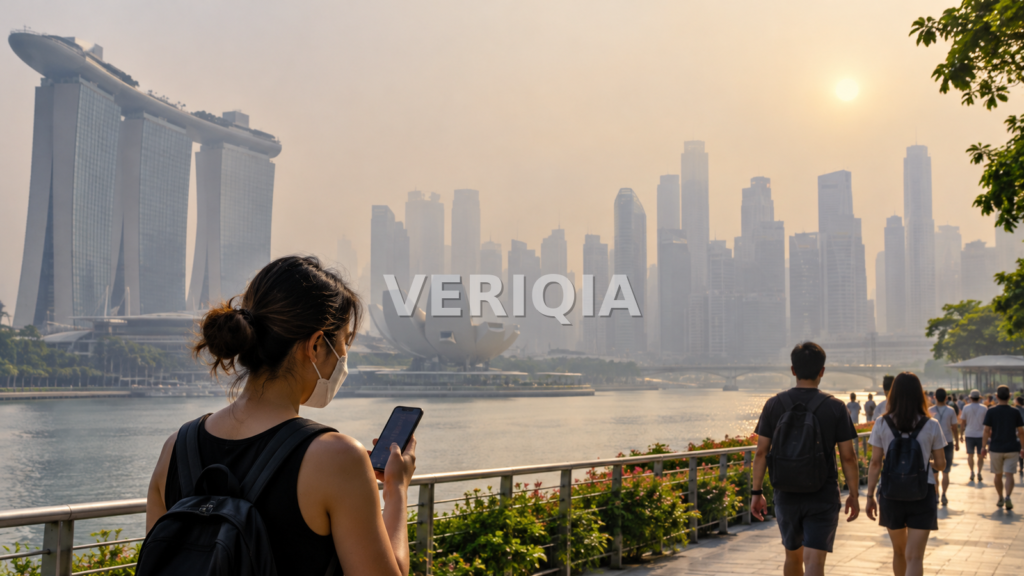
Singapore’s current haze episode has pushed the 24-hour Pollutant Standards Index into the Unhealthy range, so the most useful step is to match your activity to the right air-quality measure. On 12 October 2026, the National Environment Agency reported 24-hour PSI readings of 118–155 and elevated 1-hour PM2.5 readings in parts of Singapore.
The two numbers answer different questions. The 1-hour PM2.5 reading is more useful for deciding what to do right now. The 24-hour PSI helps with broader planning for the day ahead.
What is PSI?
PSI stands for Pollutant Standards Index. It combines the concentrations of several major air pollutants into one air-quality indicator. During haze episodes, fine particles known as PM2.5 are often a major concern because they are small enough to reach deep into the lungs.
Singapore classifies PSI levels into bands. A 24-hour PSI above 100 is in the Unhealthy range. That does not mean everyone must stay indoors, but it does mean prolonged or strenuous outdoor exertion should be reduced, especially for more vulnerable people.
What is 1-hour PM2.5?
PM2.5 refers to particles with a diameter of 2.5 micrometres or less. The 1-hour PM2.5 reading gives a more immediate picture of fine-particle levels.
If you are deciding whether to go for a run, take children to a long outdoor activity or do physical work outside in the next hour, this is the reading to watch closely.
Why can PSI and PM2.5 tell you different things?
Air quality changes through the day. A 24-hour PSI smooths conditions over a longer period, while a 1-hour PM2.5 reading can rise or fall more quickly.
That means you can have an Unhealthy 24-hour PSI but a better short-term PM2.5 window for a brief necessary trip. The reverse can also happen: a sudden rise in PM2.5 may make strenuous activity a poor idea even before the longer-term PSI changes much.
What should healthy adults do during Unhealthy haze?
Official guidance for healthy people is generally to reduce prolonged or strenuous outdoor physical exertion when the 24-hour PSI is in the Unhealthy range.
That does not automatically mean cancelling every short walk or commute. A practical approach is to:
- check the latest 1-hour PM2.5 before exercise;
- move hard workouts indoors if readings are elevated;
- shorten time spent outside if your eyes, nose or throat become irritated;
- drink water and take breaks; and
- keep indoor air as clean as reasonably possible.
Who should be more cautious?
Children, older adults, pregnant women and people with chronic heart or lung disease should take more care because they may be more sensitive to fine-particle pollution.
People with chronic heart or lung conditions should keep their usual medicines available and follow their doctor’s instructions. If symptoms become unusually severe, seek medical care rather than relying only on air-quality apps.
When does an N95 mask help?
An N95 respirator can reduce exposure to fine particles when it fits the face properly. But it is not necessary for every short outdoor trip during moderate or unhealthy haze.
Singapore’s health guidance says healthy people generally do not need an N95 for short-term exposure such as commuting. It becomes more relevant for people who must spend several hours outdoors when air quality is much worse, especially in the Very Unhealthy or Hazardous range.
A loose mask or one with a poor seal will not provide the same particle protection. People with serious heart or lung conditions who find respirators difficult to breathe through should get medical advice before prolonged use.
Does an ordinary surgical mask protect against haze?
A standard loose-fitting surgical mask is designed mainly for droplets and splashes. It does not seal tightly around the face, so it is less effective against the tiny airborne particles that are most relevant during haze.
If particle protection is needed, a properly fitted particulate respirator such as an N95 is the more appropriate type.
What caused the current haze?
Singapore’s environmental agency said smoke from fires in parts of Kalimantan and southern Sumatra was being carried toward Singapore by prevailing winds. Rain can temporarily improve conditions, but changes in wind direction and continuing fires can bring smoke back.
This is why haze can change faster than a simple daily forecast suggests.
How is haze different from normal city air pollution?
Haze is often driven by regional smoke transport, while urban air pollution can also come from traffic, industry and local combustion. Both can raise fine-particle exposure, but the sources and timing can be different.
For another example of how cities respond to air-pollution pressure, see VERIQIA’s report on Delhi’s stricter vehicle-pollution checks ahead of winter.
Simple decision guide
| Situation | What to check | Practical response |
|---|---|---|
| Short commute | 1-hour PM2.5 and how you feel | Usually continue, but reduce exposure if readings spike or symptoms appear. |
| Outdoor workout | 1-hour PM2.5 | Move indoors or reduce intensity when fine-particle levels are elevated. |
| Planning tomorrow | 24-hour PSI forecast | Use the forecast to schedule or shorten prolonged outdoor activities. |
| Several hours outdoors | Both PSI and PM2.5 | Consider stronger precautions if air quality becomes very unhealthy or hazardous. |
The bottom line
During Singapore’s haze, do not treat one air-quality number as the whole story. Use 1-hour PM2.5 for immediate decisions and the 24-hour PSI for broader planning. Most healthy people can still handle short necessary outdoor trips, but long, strenuous exposure should be reduced when air quality is unhealthy. N95 masks are most useful when exposure is prolonged and particle levels are much higher, provided the mask fits properly.