India Renewable Energy Goals: Solar, Wind, Storage and Grid Challenges
India’s renewable-energy transition involves building more solar and wind power while upgrading transmission, storage and power-market systems so electricity can reach customers when they need it. A capacity announcement is not the same as yearly electricity generation, and a solar farm’s nameplate rating is not the power it supplies after sunset. To evaluate progress, examine installed capacity, actual output, grid reliability and the pace of complementary investments together.
Capacity versus generation
Electricity capacity is usually expressed in megawatts or gigawatts, while generation over time is measured in kilowatt-hours or larger energy units. A solar installation produces strongly during daylight and less under heavy cloud; wind output depends on weather. Thermal, hydro, nuclear and renewable technologies have different operating patterns. Comparing capacity percentages with electricity-generation percentages is a common source of confusion. A country can add substantial solar capacity without solar providing the same share of electricity every hour.
Why targets have several definitions
Energy targets may concern non-fossil installed capacity, renewable generation, emissions intensity, consumption or long-term climate goals. These are not interchangeable. Hydropower and nuclear generation can be treated differently across targets and datasets. A carefully written article should quote the exact target wording and date from a government document instead of saying all electricity will be renewable by a certain year. That difference is central to understanding both progress and remaining work.
Solar expansion
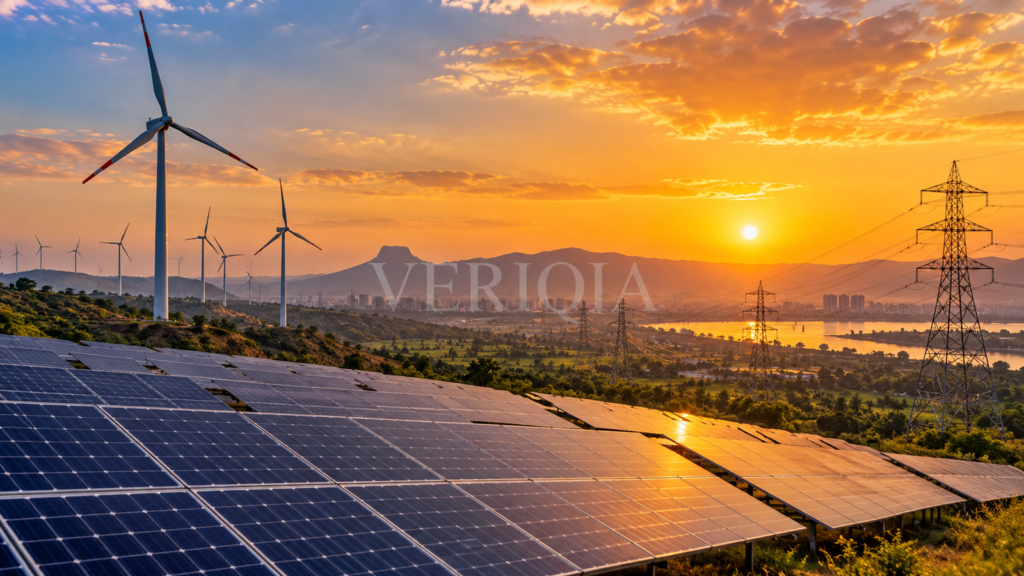
Large utility-scale solar parks can offer lower per-unit costs where land, sun exposure and grid connections are suitable. Rooftop systems can put generation closer to customers, but depend on building permissions, metering arrangements and reliable installers. Solar creates new demand for panels, inverters, maintenance and transmission infrastructure. Projects still face land-use questions and supply-chain risks. Commissioned installations, not only sanctioned project pipelines, reveal how much capability has truly entered service.
Wind and regional diversity
Wind power has different geographic and seasonal profiles from solar generation. Onshore wind farms may be sited along suitable coasts, ridges or inland corridors. Repowering older sites, forecasting output and connecting remote production areas are important alongside new turbines. Regional differences matter: a state with strong solar resources may not have matching wind potential, and demand centers may lie far away. A diversified mix can ease some variability but does not remove the need for dispatchable flexibility.
Storage and flexible power
Grid-scale batteries can shift limited amounts of electricity from one time of day to another and provide rapid balancing services. Pumped storage can move water uphill when electricity is abundant and release it later through turbines. Neither technology creates energy; both lose some energy in the storage cycle and require financing and suitable operating conditions. Their value depends on peak demand, grid constraints and the duration of shortages. Storage capacity in megawatts is not the same as stored energy in megawatt-hours.
Transmission is a separate project
Renewable-rich areas may be far from major cities and industries. New transmission lines, substations and scheduling arrangements are needed to deliver electricity reliably. A solar park that is technically finished but unable to export full output because the grid connection is delayed cannot produce its intended benefit. Land permits and right-of-way disputes can affect transmission too. When reading a progress report, ask if the generation project and associated grid infrastructure are both ready.
Costs and who pays
Lower solar or wind generation costs do not mean the entire electricity system becomes free or equally cheap. Networks, backup, storage, balancing, financing and distribution losses still matter. Tariff structures also determine who benefits and when. Households may face different prices from industrial users. When evaluating a new scheme, check eligibility, upfront investment, maintenance obligations and how payments are calculated rather than assuming an advertised saving applies to every customer.
Reliability and demand growth
Electricity use rises and shifts as industry, cooling, transport and digital infrastructure expand. A successful transition must meet growing demand while limiting environmental impact. Peak summer evenings can be challenging because cooling demand remains high as solar generation declines. Good planning combines energy efficiency, flexible generation, storage, transmission and demand-response programs. A record renewable output on one day is encouraging, but annual reliability depends on performance across many seasons and operating conditions.
Jobs, manufacturing and land
Renewable projects can create installation, engineering, operations and equipment-manufacturing jobs. Their number and duration depend on the project stage and local supply chain. Solar parks and wind farms also need land, access roads and consultations with affected communities. Environmental trade-offs should not be ignored simply because the electricity is low-carbon. Transparent siting, recycling plans and fair compensation policies improve long-term public acceptance and can reduce delays.
How to track official progress
Use periodically published capacity and generation statistics from the relevant energy ministry, power regulator or system operator. Compare consistent dates and definitions, and distinguish under-construction pipelines from commissioned assets. For a rooftop subsidy, check the official portal and current eligibility rules. For a big grid project, locate commissioning notices. A sensible scorecard includes new solar and wind, storage duration, inter-state transmission, coal generation trends and power cuts, rather than one heroic headline number.
Bottom line
Renewable electricity expands through a linked system of projects rather than a single announcement. India’s opportunity is substantial, but actual results depend on construction, grid access, storage, predictable policy and demand. To assess claims, ask what capacity was commissioned, how much energy it generated, whether the network can deliver it and what people pay. Those questions provide a durable way to read both official updates and competing commentary.
Frequently asked question
Does higher renewable capacity mean every hour is greener?
Not necessarily. Output varies by time, season and grid conditions, so generation data is needed for that comparison.